Calorie tracking has a reputation problem. Mention it to most people and you'll get one of two reactions: either they've tried it before and found it obsessive, tedious, and unsustainable — or they've never tried it because the very idea sounds miserable. And to be fair, poorly implemented calorie tracking can be all of those things.
But here's what the critics miss: done right, calorie tracking is the single most effective tool for understanding your diet, reaching your health goals, and maintaining results long-term. Research from the National Weight Control Registry — the largest study of successful long-term weight loss — found that 78% of people who lost weight and kept it off for more than five years tracked their food intake in some form.
The key phrase is "done right." This guide will show you how to track calories in a way that's simple, sustainable, and actually improves your relationship with food instead of destroying it. No obsessive measuring, no guilt spirals, no calorie anxiety — just practical knowledge that puts you in the driver's seat of your nutrition.
What Are Calories, Really? A Quick Science Primer
A calorie is simply a unit of energy. Specifically, it's the amount of energy needed to raise the temperature of 1 kilogram of water by 1 degree Celsius. When we talk about "calories" in food, we're talking about kilocalories (kcal), though the terms are used interchangeably in everyday conversation.
Your body needs calories to perform every function: breathing, circulating blood, maintaining body temperature, thinking, digesting food, and of course, physical movement. The total energy your body uses in a day is called your Total Daily Energy Expenditure (TDEE), and it's made up of three components:
- Basal Metabolic Rate (BMR): The calories your body burns at rest just to keep you alive — about 60-70% of your TDEE
- Thermic Effect of Food (TEF): The energy used to digest and process food — about 10% of TDEE
- Activity Level: Calories burned through exercise and daily movement — about 20-30% of TDEE
The fundamental equation of weight management is simple: if you consume more calories than your TDEE, the excess is stored (primarily as fat). If you consume fewer, your body draws on stored energy. If you match your TDEE, your weight stays stable. Calorie tracking gives you the data to control this equation precisely.
Step 1: Calculate Your TDEE
Before you can track meaningfully, you need to know your target. The most widely validated method for estimating TDEE begins with the Mifflin-St Jeor equation, which research has shown to be the most accurate predictive formula for most adults:
For men: BMR = (10 × weight in kg) + (6.25 × height in cm) – (5 × age) + 5
For women: BMR = (10 × weight in kg) + (6.25 × height in cm) – (5 × age) – 161
Then multiply by an activity factor:
| Activity Level | Multiplier | Description |
|---|---|---|
| Sedentary | 1.2 | Desk job, little to no exercise |
| Lightly Active | 1.375 | Light exercise 1-3 days/week |
| Moderately Active | 1.55 | Moderate exercise 3-5 days/week |
| Very Active | 1.725 | Hard exercise 6-7 days/week |
| Extra Active | 1.9 | Athlete or very physical job + exercise |
Example: A 30-year-old woman, 5'6" (168 cm), 150 lbs (68 kg), moderately active: BMR = (10 × 68) + (6.25 × 168) – (5 × 30) – 161 = 680 + 1050 – 150 – 161 = 1,419 TDEE = 1,419 × 1.55 = 2,199 calories/day
This is her estimated maintenance level. For weight loss, she'd aim for 300-500 calories below this (approximately 1,700-1,900 calories). For weight gain, she'd add 300-500 above.
⚠️ Important: TDEE Is an Estimate
Your calculated TDEE is a starting point, not a precise measurement. Individual metabolism varies by 10-15% based on genetics, gut microbiome, hormone levels, and other factors. The practical approach: start with your calculated TDEE, track for 2-3 weeks, and adjust based on actual results. If you're losing weight too quickly (more than 1-1.5 lbs/week), increase calories slightly. If not losing at all, decrease by 100-200 calories.
Step 2: Understand Macronutrients
Calories tell you how much energy you're consuming. Macronutrients tell you what kind of energy — and this distinction matters enormously for health, body composition, energy levels, and satiety.
The Three Macros
Protein (4 calories per gram) — The most important macro for most health goals. Protein builds and repairs muscle, creates enzymes and hormones, supports immune function, and is the most satiating macronutrient (it keeps you full longest). Aim for 0.7-1.0 grams per pound of bodyweight, or about 25-35% of total calories.
Carbohydrates (4 calories per gram) — Your body's preferred fuel source, especially for the brain and high-intensity exercise. Not all carbs are equal: complex carbs (whole grains, vegetables, legumes) provide sustained energy with fiber, while simple carbs (sugar, white bread) cause rapid blood sugar spikes. Understanding how to read nutrition labels helps you distinguish between the two. Aim for 35-50% of total calories, primarily from complex sources.
Fat (9 calories per gram) — Essential for hormone production, brain function, vitamin absorption, and cell membrane integrity. Despite old dietary advice, dietary fat doesn't make you fat — excess calories do. Focus on unsaturated fats (olive oil, nuts, avocado, fish) while limiting saturated fats. Aim for 20-35% of total calories.
Sugar: The Macro Within the Macro
Sugar is a type of carbohydrate, but it deserves special attention. The added sugars in your diet — the sugars manufacturers put into processed foods — contribute calories without any nutritional benefit. Tracking your sugar intake alongside your overall calorie count gives you a much clearer picture of your nutritional quality. This is exactly where apps like SugarWise excel: they track calories, macros, and sugar simultaneously, revealing hidden sugars that might be sabotaging your goals.
Step 3: Choose Your Tracking Method
Method 1: App-Based Tracking (Recommended)
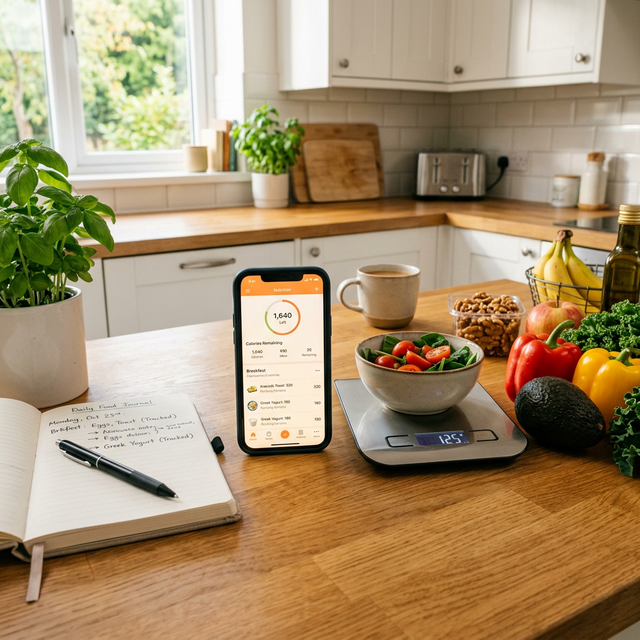
This is the most popular and practical method for most people. A good nutrition tracking app provides a food database with thousands to millions of entries, barcode scanning for packaged foods, meal templates for frequently eaten combinations, and visual dashboards showing your daily/weekly progress. SugarWise stands out because it specifically highlights sugar content alongside standard calorie and macro tracking — critical for anyone concerned about sugar's effects on health.
Method 2: The Portion Estimation Method
For people who find detailed tracking too tedious, the hand-portion method offers a practical alternative. Use your hand as a measuring tool: a palm-sized portion of protein (20-30g), a fist-sized portion of vegetables, a cupped-hand portion of carbs, and a thumb-sized portion of fats. While less precise than app tracking, this method eliminates the need for scales and measuring cups.
Method 3: Photo Journaling
Simply photographing every meal creates awareness without the burden of logging specific numbers. Research shows that the act of documenting food intake — even without calculating calories — reduces overall consumption by 15-20% because it forces mindful consideration before eating.
The Easiest Way to Start Tracking
SugarWise tracks calories, macros, and sugar in one intuitive interface. Log meals in seconds, scan barcodes, set personalized goals, and get insights that make healthy eating simple.
Step 4: Master Portion Awareness
The number-one reason calorie tracking fails isn't lack of discipline — it's inaccurate portion estimation. Studies consistently show that people underestimate their calorie intake by 30-50%. Here's how to build accurate portion awareness:
Week 1: Use a Food Scale
For the first week, weigh everything you eat on a kitchen food scale. This sounds extreme, but it's temporary and wildly educational. You'll discover that your "tablespoon" of peanut butter is actually two tablespoons (80 extra calories), your "cup" of rice is actually 1.5 cups (100 extra calories), and your "serving" of cheese is actually three servings (200 extra calories). These calibration errors add up to 400-600 hidden calories per day.
Week 2-3: Transition to Estimation
After a week of weighing, your visual estimation skills will be dramatically improved. You'll know what 4 ounces of chicken actually looks like, how much a real tablespoon of oil is, and what 1 cup of pasta looks like on your plate. Transition to estimating, using the scale periodically to check your accuracy.
Week 4+: The 80/20 Approach
By week four, aim for "good enough" tracking — logging the major components of each meal without obsessing over exact measurements. Track about 80% of your intake accurately and accept that 20% will be estimated. This level of accuracy is more than sufficient for achieving and maintaining results.
The 7 Biggest Calorie Tracking Mistakes (and How to Avoid Them)
Mistake 1: Not Counting Cooking Oils and Condiments
A tablespoon of olive oil adds 120 calories. A generous pour while cooking can easily hit 3-4 tablespoons — that's 360-480 invisible calories. Similarly, condiments like mayo (94 cal/tbsp), ranch dressing (73 cal/tbsp), and sugar-laden sauces add significant calories that go untracked if you're not paying attention.
Mistake 2: Weekend Amnesia
Many people track diligently Monday through Friday, then abandon tracking on weekends. The problem? Two days of unrestricted eating can completely erase a week's calorie deficit. If you're in a 500-calorie deficit Monday-Friday (saving 2,500 calories), but overeat by 1,500 calories on both Saturday and Sunday, you've wiped out your entire weekly deficit. Track on weekends, even if loosely.
Mistake 3: Forgetting Liquid Calories
Coffee drinks, juices, smoothies, alcohol, and even milk in your cereal all contain calories. A large flavored latte (250-400 cal), a glass of wine (120-150 cal), or a bottle of juice (220-300 cal) can represent 15-25% of some people's daily calorie budget. Liquid calories are especially dangerous because they don't trigger satiety the way solid food does, as we explain in our sugar swaps guide.
Mistake 4: Setting Too Aggressive a Deficit
Eating 1,000 or 1,200 calories when your TDEE is 2,200 might produce fast scale changes initially, but it's metabolically counterproductive and psychologically unsustainable. Extreme deficits increase muscle loss, slow metabolism, trigger intense cravings, and almost always result in binge-restrict cycles.
Mistake 5: Ignoring Protein
Focusing only on total calories without attention to protein intake leads to muscle loss during dieting, increased hunger (protein is the most satiating macro), and poor body composition outcomes. Before worrying about total calories, hit your protein target first.
Mistake 6: Tracking Only on "Good" Days
Your tracking data is most valuable when it captures your actual eating patterns, including the bad days. Logging an 800-calorie binge isn't failure — it's data. That data reveals triggers, patterns, and emotional eating habits that you can only address if you're aware of them.
Mistake 7: Making It Too Complicated
You don't need to track every micronutrient, every supplement, and every gram of fiber from day one. Start with calories and protein — just those two numbers. Once that feels comfortable (usually 2-3 weeks), add sugar tracking. Then carbs and fats. Building complexity gradually prevents overwhelm and improves long-term adherence.
Calorie Tracking FAQs
How many calories should I eat per day to lose weight?
A safe and sustainable calorie deficit is 300-500 calories below your TDEE. For most adults, this means consuming 1,500-2,200 calories daily, depending on age, sex, height, weight, and activity level. Use the Mifflin-St Jeor equation above to calculate your personal TDEE, then subtract 300-500 calories. Aim to lose 0.5-1.5 pounds per week.
Is calorie counting necessary for weight loss?
Calorie counting isn't the only path to weight loss, but it's one of the most reliable. The National Weight Control Registry shows that 78% of successful long-term weight maintainers track their food in some form. Even tracking for just 2-4 weeks provides invaluable awareness of your eating patterns and portion sizes.
What's the difference between calories and macros?
Calories measure the total energy content of food. Macros (macronutrients) are the three nutrient categories that provide those calories: protein (4 cal/g), carbohydrates (4 cal/g), and fat (9 cal/g). Tracking macros is a more detailed approach that ensures you're getting the right balance of nutrients, not just the right total number.
How long should I track calories?
We recommend tracking actively for at least 4-8 weeks. This provides enough data to understand your patterns and builds portion awareness that persists even after you stop logging. Many people transition to intuitive eating informed by their tracking experience — they've internalized portion sizes and know which foods support their goals without needing to log every meal.
Your First Week: A Practical Quick-Start Guide
- Day 1: Download SugarWise. Calculate your TDEE. Set your daily calorie and sugar goals in the app.
- Days 2-3: Track everything you eat normally — don't try to change your diet yet. The goal is to see your baseline, which is often eye-opening.
- Days 4-5: Review your data. Where are the biggest calorie and sugar sources? Identify 1-2 easy wins — often sugary drinks and oversized portions.
- Days 6-7: Implement your easy wins. Replace one calorie-dense habit with a lower-calorie alternative. Start aiming for your protein target.
By the end of week one, you'll have more knowledge about your actual diet than most people gain in a lifetime of eating. And that knowledge — not willpower, not restriction, not guilt — is what drives lasting change.
Start Tracking in Under 60 Seconds
SugarWise makes calorie and sugar tracking effortless. Log meals instantly, track macros visually, and get personalized insights that keep you motivated and on track.
Download SugarWise on Google Play →