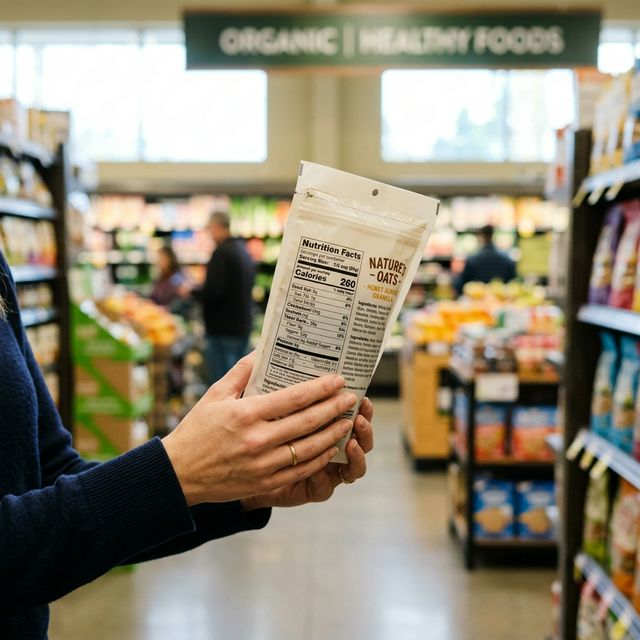
Here's an uncomfortable truth: food companies spend billions of pounds on packaging specifically designed to stop you reading the nutrition label. They don't want you looking at the back of the packet. They want you distracted by the front — "All Natural!" "Heart Healthy!" "Made with Real Fruit!" "Low Fat!" — while the actual nutrition information tells a completely different story.
Learning to read a food label takes about 5 minutes. Once you've got it, you'll never look at a supermarket the same way again. You'll see through the hidden sugar tricks, the misleading serving sizes, and the marketing nonsense that's been influencing your purchases for years. Let's break it down.
The 3-Second Label Check
You don't need to analyse every number on the panel. In a hurry? Check these three things:
- Serving size — Is it realistic? A jar of pasta sauce might list nutrition per "quarter serving" (60ml) when you'll use half the jar (250ml).
- Added sugar — Under 5g per serving = good. Over 10g = put it back.
- First 3 ingredients — Ingredients are listed by weight. If sugar (or any of its aliases) appears in the top 3, the product is a sugar bomb.
This takes 5 seconds. Do it with every new product and you'll automatically filter out the worst offenders.
Understanding the Nutrition Panel
Serving Size: The Most Important (and Most Abused) Number
Manufacturers choose their own serving sizes — and they consistently choose unrealistically small ones to make the numbers look good. A "serving" of ice cream is 65g — about 3 tablespoons. Nobody in the history of humanity has eaten 3 tablespoons of ice cream and put the tub away. A "serving" of crisps is often 25g — about 10 crisps. A "serving" of cereal is 30g — roughly a handful.
Always multiply the per-serving numbers by how much you'll actually eat. If you'll eat half the packet, double everything. SugarWise does this automatically when you log your food.
Total Sugar vs. Added Sugar
This is the single most confusing part of food labels — and companies exploit it deliberately. Total sugar includes both natural sugars (from fruit, milk) and added sugars (the bad stuff). Added sugar is what you need to watch.
A pot of plain yoghurt has ~5g of total sugar from naturally occurring lactose — that's fine. A pot of strawberry yoghurt has ~19g — the extra 14g is added sugar. Always look for the "of which added sugars" line. If the label doesn't separate them (some older labels don't), check the ingredient list for sugar's many aliases.
The Ingredient List: Where the Truth Lives
Ingredients are listed in descending order by weight. The first ingredient is what the product contains most of. If you're looking at a "whole grain" bread and the first ingredient is "enriched wheat flour," it's not really whole grain — it's white bread with marketing.
Three rules for the ingredient list:
- Shorter is better. A product with 5 ingredients is almost always healthier than one with 35.
- If you can't pronounce it, be cautious. Maltodextrin, sodium benzoate, tertiary butylhydroquinone — these are ultra-processed additives. Occasional exposure is fine; making them a dietary staple is not.
- Watch for sugar splitting. Companies list multiple forms of sugar separately so none of them appears first. A product might list "sucrose, high-fructose corn syrup, dextrose, molasses" as separate ingredients — each one ranks lower individually, but combined they might be the primary ingredient.
🕵️ The 56+ Names for Sugar
Sugar hides behind dozens of aliases on food labels. The most common: sucrose, high-fructose corn syrup, dextrose, maltose, glucose, fructose, corn syrup, cane sugar, invert sugar, malt syrup, rice syrup, agave nectar, coconut sugar, honey, treacle, molasses, and fruit juice concentrate. Quick rule: anything ending in "-ose" is a sugar. If you spot more than one form of sugar in the ingredient list, the total sugar content is likely very high.
Skip the Label Math — Let SugarWise Do It
Scan a barcode and SugarWise instantly shows you the sugar, calories, and macros per serving — adjusted to the amount you're actually eating. No calculation required.
Front-of-Pack Claims: What They Actually Mean
The front of a food package is advertising, not information. Here's what the most common claims really mean:
"Natural"
Means almost nothing. There's no legal definition of "natural" in most countries. Arsenic is natural. So is cyanide. A product labelled "all natural" can still contain massive amounts of sugar, because sugar comes from sugarcane — which is, technically, natural. Ignore this word entirely.
"No Added Sugar"
Means the manufacturer didn't add sugar during processing — but the product can still contain high levels of natural sugar. Fruit juice labelled "no added sugar" often has 20-30g of sugar per glass from the fruit itself. Always check total sugar on the nutrition panel.
"Low Fat"
A classic con. When fat is removed, sugar is almost always added to maintain taste. "Low-fat" yoghurts, muffins, and salad dressings frequently contain more sugar than their full-fat versions. Fat isn't the enemy — excess sugar is.
"High in Protein"
This one's abused heavily by snack bars and "protein" products. To make the claim, a product only needs 20% of energy from protein (EU) or 10g+ per serving (US). But many "high-protein" products also contain 15-20g of sugar. Check both numbers — protein AND sugar. A product with 15g protein and 18g sugar is not a health food.
"Wholegrain" or "Multigrain"
"Multigrain" just means "contains more than one grain" — it doesn't mean they're whole grains. A multigrain bread can be mostly refined white flour with a sprinkle of seeds for appearances. Look for "100% whole grain" and check that the first ingredient is actually a whole grain (whole wheat flour, rolled oats, brown rice).
The Quick Reference: What's Good, What's Not
Per Serving Thresholds (Quick Check)
- Sugar: ✅ Under 5g | ⚠️ 5-10g | ❌ Over 10g
- Fibre: ✅ Over 3g | ⚠️ 1-3g | ❌ Under 1g
- Protein: ✅ Over 10g | ⚠️ 5-10g | ❌ Under 5g
- Sodium: ✅ Under 300mg | ⚠️ 300-600mg | ❌ Over 600mg
- Ingredients: ✅ Under 10 items | ⚠️ 10-20 | ❌ Over 20 (ultra-processed territory)
5 Real-World Examples
1. "Healthy" Granola Bar
Front label: "Made with real oats and honey. Good source of fibre." Back label: 12g sugar, 3g protein, and the first three ingredients are oats, sugar, and glucose syrup. The honey they prominently feature? It's the 8th ingredient. This is a confectionery bar wearing a hiking outfit.
2. "Protein" Yoghurt
Front label: "20g protein! High protein!" Back label: 20g protein, 16g sugar. Brilliant — you're getting your protein alongside two-thirds of your daily added sugar limit. A plain Greek yoghurt gives you the same protein with 4g of natural sugar. Marketing vs reality.
3. "Low-Sugar" Pasta Sauce
Front label: "50% less sugar!" Back label: 6g sugar per serving. That might sound reasonable until you realise the original had 12g — so "50% less" just means it went from terrible to mediocre. Make your own with tinned tomatoes, garlic, and herbs — virtually zero added sugar and ready in 15 minutes.
4. Fruit Smoothie
Front label: "No added sugar. 2 of your 5 a day." Back label: 34g total sugar per bottle. Yes, it's "natural" fruit sugar, but once blended and stripped of fibre, it hits your bloodstream like a can of Fanta. Your body doesn't distinguish between "natural" and "added" glucose floating freely in a liquid.
5. "Wholegrain" Cereal
Front label: "Whole grain goodness. Heart healthy." Back label: First ingredient: "whole grain wheat." Second ingredient: "sugar." Third: "glucose-fructose syrup." The cereal contains more sweeteners than any other ingredient after wheat. "Heart healthy" is an unregulated marketing term in most countries.
Food Label FAQs
What should I look for first on a food label?
Three things, in this order: (1) Serving size — is it realistic? (2) Added sugar — under 5g is solid. (3) First 3 ingredients — if sugar features here, skip it. This takes 5 seconds and filters out most hidden sugar bombs.
What are the different names for sugar?
Over 56 names. The most common: sucrose, HFCS, dextrose, maltose, glucose, fructose, corn syrup, cane sugar, agave, honey, and anything ending in "-ose." Companies use multiple forms to push sugar lower in the ingredient list — a deliberate strategy to make products look lower in sugar than they are.
Is "no added sugar" the same as sugar-free?
No. "No added sugar" means nothing was added during manufacturing — but natural sugars can still be very high. "Sugar-free" means less than 0.5g per serving. Always check the total sugar line regardless of front-of-pack claims. Your daily limit doesn't care whether the sugar was "added" or "natural" — your body processes both identically.
Start Reading Labels. Everything Changes.
Once you see through the marketing — once you develop the habit of flipping a product over and checking those three numbers — you can never unsee it. You'll be angry at first (companies have been getting away with this for decades). Then you'll be empowered, because every purchase becomes an informed decision instead of a manipulated one. The supermarket goes from being a minefield to being manageable. And your diet improves automatically, without willpower, without restriction — just awareness. Start today. Flip the packet.
Let SugarWise Read the Label For You
Scan any barcode and get instant, honest nutrition facts — sugar, protein, calories, and a simple good/bad rating. No more squinting at tiny print.